The Mystery of the Mona Lisa Solved Through Nonverbal Communication

Many have tried to demystify the mysterious smile of the most famous painting in the world:

Leonardo da Vinci’s Mona Lisa, painted in the early 16th century.

While many have described this face with mixed emotions (83% happiness, 9% disdain, 6% fear, etc.), this article is the first to really look into the person’s state of mind, through her nonverbal expression.

This site offers an approach based on facial asymmetry, which corresponds to a double emotion: a kind of disguised emotion. (You can also click on each photo to see a larger version and better see the double emotions.) Note: by left and right, we mean the other person’s left and right….

Portrait of the Mona Lisa showing a woman with a mysterious smile and a blurred landscape in the background
Face of a young woman with a neutral facial expression and a slight smile

What can an asymmetrical face tell us?

An asymmetrical face reveals 2 different states of mind. When the face is divided in two (left half and right half), two entirely different emotions can be seen, one on each half. So while the left side of her face expresses happiness, the right side expresses sadness. That is exactly what happens in the following photo (Ms. Susan Smith). Of course, in everyday life it is not easy to perceive, but with practice it can be done.

The right side of the face is what the person shows to others….

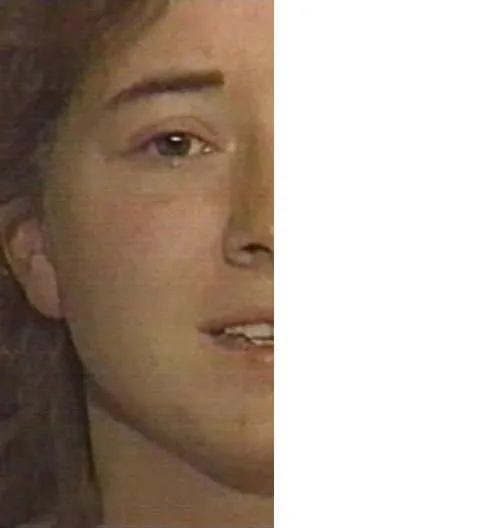
Here, this woman begs the kidnapper to give her children back. When her children disappeared, Susan Smith helped produce a composite sketch to identify the person who had supposedly kidnapped them. It is very easy to see (read) the pain Smith is trying to convey to the media. You can even see a tear forming under her right eye.

The right side of the face is what we try to convey to others. Here, clearly, it is sadness that is conveyed.
The left side of the face is the self: it is what the person truly feels.

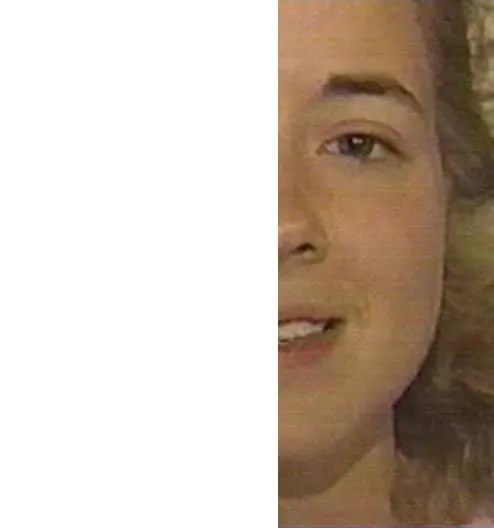
While she shows sadness on the right side of her face, she shows a real smile on the other side of her face (on her left: the side that shows you what she feels inside). On this half of the face, you can see a person who is laughing and telling herself: everything is going well, I am getting away with it…. (In fact, she herself drowned her two children.)

While the person’s ‘act’ is played out on the right, her true emotion can be read on the left side of her face.

Left half of the face of a brown-haired woman with a neutral expression
The right side of the face is what we try to convey to others.
Right half of the face of a smiling woman with curly blond hair
Emotion can be read on the left side of the face

The right side is what is shown to others 

The right half of the face shows neutrality. It is a neutral person, expressing neither sadness nor pleasure (unlike the other side of the face). The lips are neutral, meaning they neither rise nor fall, probably at the painter’s request (Please don’t smile.)

The left side is what the person truly feels

The Mona Lisa is being painted by the greatest painter of the time (Leonardo da Vinci); the woman feels great satisfaction, and that is what the left side of her face expresses.

The lips turn upward, a sign of pleasure and well-being.

Portrait of the Mona Lisa showing a woman with a mysterious smile and a blurred landscape in the background

Here is another example of a face expressing two emotions at the same time:

Serge Chapleau, a guest on the TV show ‘Tout le monde en parle’, launches quite an attack on Rael (the leader of a sect who claims to have met extraterrestrials) with the following line: ‘Excuse me, my man, but: Claude, this is a joke!’

On Serge Chapleau’s left, half a face that is privately amused.

The left side is what the person truly feels

On Serge Chapleau’s right, half a face that means to be threatening. He is attacking Rael.

The right side is what is shown to others 

White-haired man looking at another person, seen from behind, during a conversation
Blurred portrait of a grey-haired man looking toward the camera

Other articles